
In the heart of Robertson County, we know that the strength of any structure—be it a family home or the ancient oaks that line our Tennessee horizons—depends entirely on the ground that holds it. Without a deep, stable foundation, even the most beautiful tree cannot reach toward the sky.
At Greenbrier Dental Excellence, we see your smile in much the same way. When a neighbor asks us, “Can you get dental implants with bone loss?” they are often asking from a place of concern. They fear that the “soil” of their jawbone has become too thin to support the “roots” of a new tooth.
Under the thoughtful guidance of Dr. Ellis, we want to reassure you: while the landscape of your mouth may have changed, the path to restoration is rarely closed. Modern dental wisdom allows us to nourish and rebuild the foundation of your smile, even after years of tooth loss.
Understanding the Landscape: Why Bone Matters
To understand the journey of dental restoration, we must first look at the relationship between your teeth and your jawbone. They exist in a state of sacred balance.
Your jawbone (the alveolar bone) stays strong and dense because of the stimulation it receives from the roots of your teeth. Every time you chew or bite, that pressure signals to your body that the bone is “needed,” and your body responds by sending nutrients to keep it thick and vibrant.
When a tooth is lost, that signal stops. Much like a path that is no longer walked upon, the body begins to reclaim that bone, moving its minerals elsewhere. This process, known as bone resorption, can lead to a thinning of the jaw within just months of losing a tooth. Because a dental implant requires a specific amount of height and width to “fuse” correctly, significant bone loss can present a challenge—but it is a challenge we are well-equipped to meet.
Can You Get Dental Implants with Bone Loss?
The short answer is a resounding yes.
While you may not be an immediate candidate today, the advancements in regenerative dentistry allow us to “heal the earth” before we plant the seed. If you have been told in the past that you lacked the bone density for implants, you should know that techniques have evolved. We no longer simply look at what is there; we look at what we can create.
To determine your specific path, we first assess your current standing. We invite you to explore our guide on who is a good candidate for dental implants to understand the broader health markers we look for, but regarding bone specifically, we focus on three main restoration techniques.
Healing the Earth: Ways We Rebuild the Foundation
If Dr. Ellis determines that your jawbone has receded, we do not simply turn you away. Instead, we discuss the “remedies” that can bring your foundation back into balance.
1. Bone Grafting (Nourishing the Soil)
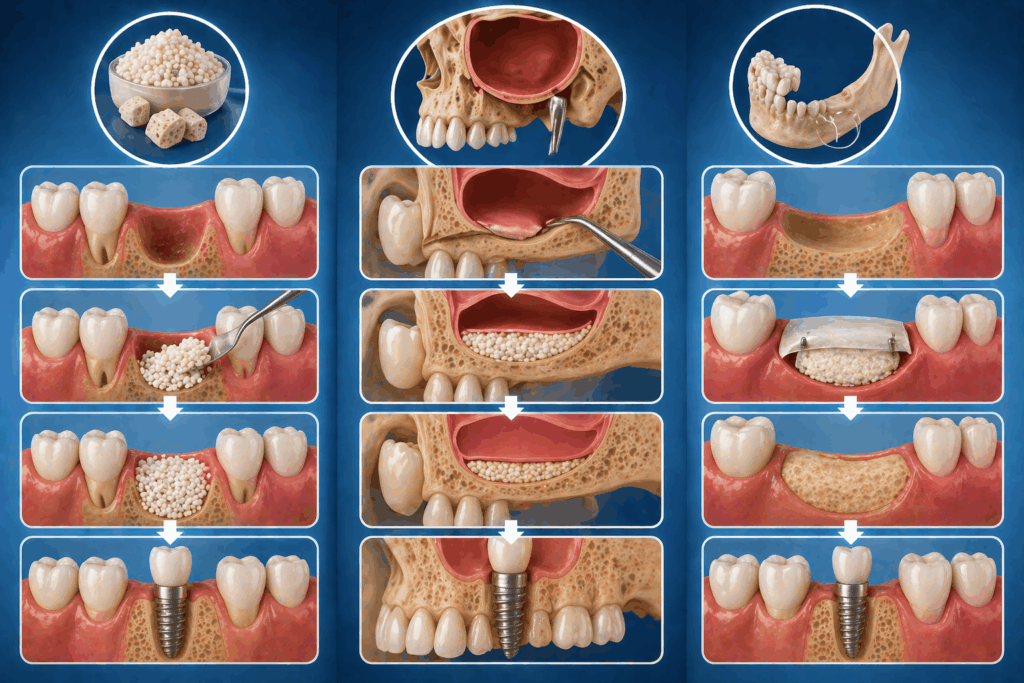
Bone grafting is the most common way we address bone loss. We place a small amount of bone-processed material into the area where the bone has thinned. This material acts as a “scaffold.” Your body’s natural wisdom takes over, using this scaffold to grow new, living bone. Over several months, the graft is replaced by your own strong, natural bone, creating a site that is ready to hold a titanium implant.
2. Sinus Lifts (Creating New Space)
For our neighbors missing teeth in the upper back jaw, the “floor” of the sinus cavity can sometimes be too close to the gum line. A sinus lift is a delicate procedure where we gently lift the sinus membrane and place bone grafting material underneath. This creates the necessary depth for an implant without disturbing the breath or the harmony of the sinus.
3. Ridge Augmentation
Sometimes, the ridge of the jaw becomes too narrow rather than too short. Through ridge augmentation, we can increase the width of the bone, ensuring that when the implant is placed, it is surrounded by a protective “embrace” of sturdy bone on all sides.
Why Restoration is Worth the Journey
Some may ask if it is worth the extra time to rebuild the bone. At Greenbrier Dental Excellence, we believe in the long-view of health. Choosing to restore the bone and place an implant provides benefits that other options cannot:
- Halting Further Loss: An implant is the only restoration that “tricks” the body into thinking the tooth root is back, which stops the bone from resorbing any further.
- Structural Harmony: Restoring the bone helps maintain the natural shape of your face. Without bone, the lower third of the face can begin to “collapse” over time, leading to a prematurely aged appearance.
- Unshakable Strength: Once the bone has healed around the implant (a process called osseointegration), your new tooth will be as stable as any natural tooth you were born with.
The Greenbrier Way: A Calm and Patient Approach
At our PPO-friendly clinic in Greenbrier, we do not believe in rushing the body. Healing takes the time it takes. If your journey requires a bone graft, we will walk with you through the “season of healing” before placing the implant.
Dr. Ellis approaches every procedure with a calm, grounded spirit. We use advanced digital imaging to map your jaw in 3D, allowing us to see exactly where the bone is thin and where it is strong. This precision ensures that we only recommend the procedures you truly need to find balance.
Frequently Asked Questions
How do I know if I have bone loss?
Usually, bone loss is invisible to the naked eye. However, if your dentures have become loose or if your face appears “sunken” around the mouth, these may be signs. We use 3D CBCT scans to measure your bone with mathematical certainty.
Does bone grafting for dental implants hurt?
Most patients describe the sensation as a dull pressure rather than sharp pain. Because we are a patient-focused clinic, we ensure you are fully comfortable during the procedure and provide clear guidance for your care at home.
How long do I have to wait for an implant after a bone graft?
The “season of healing” typically lasts between 3 and 6 months. This allows your body to fully integrate the new bone material, ensuring the foundation is rock-solid before we move forward.
Is bone loss a common reason for dental implant failure?
Yes, placing an implant into “weak soil” is a leading cause of failure. This is why Dr. Ellis is so diligent about ensuring your bone density is sufficient before the implant is placed. We believe in doing it right the first time.
Can I get “all-on-4” if I have bone loss?
Often, yes! Procedures like “All-on-4” use angled implants to take advantage of the denser bone that remains in the front of the jaw, sometimes bypassing the need for extensive grafting in the back.