
In the quiet stretches of Middle Tennessee, we understand that a house is only as strong as its foundation and a community is only as resilient as the health of its people. At Greenbrier Dental Excellence, we view oral health not as a series of isolated repairs, but as a journey toward restoration and balance.
When a tooth is lost, it is more than just a gap in a smile; it is a break in the harmony of your “bite,” affecting how you speak, how you nourish yourself, and how you present your spirit to the world. For many of our neighbors in Greenbrier, dental implants offer a way to restore that lost balance with a permanent, root-like foundation.
But is this path right for everyone? To walk this path successfully, one must have the right landscape. In this guide, we will explore the essential markers of who is a good candidate for dental implants, grounded in clinical excellence and a commitment to your long-term well-being.
The Root of the Matter: What is a Dental Implant?
Before determining candidacy, we must understand the “why” behind the technology. Unlike traditional options that sit atop the gums, a dental implant is a small post, typically made of biocompatible titanium, that acts as an artificial tooth root.
Through a natural process called osseointegration, your jawbone actually grows around this post, fusing it into your anatomy. This creates a bond as strong as a natural tooth. However, because the implant relies so heavily on your body’s ability to heal and the strength of your bone, certain “environmental” factors in your mouth must be met.
1. The Foundation: Sufficient Bone Density
Just as a mighty oak requires deep, firm soil to withstand the Tennessee winds, a dental implant requires a sturdy jawbone to remain secure.
When a tooth is missing for a long period, the bone beneath it begins to “melt away” or resorb because it no longer has a root to stimulate it. A prime candidate for implants is someone who still possesses enough bone volume and density to “anchor” the titanium post.
What if your “soil” is thin?
Many patients worry that bone loss disqualifies them immediately. This is a common misconception. Often, we can perform a bone graft to strengthen the area. If you find yourself wondering, can you get dental implants with bone loss, the answer is frequently “yes,” provided you are willing to undergo the preparatory steps to build a stronger foundation.
2. The Soil: Healthy Gum Tissue
The gums are the protectors of your teeth and implants. They act as a seal, keeping harmful bacteria away from the bone and the implant site.
To be a good candidate, your gums must be free of periodontal (gum) disease. If there is active infection, it can travel down the implant post and prevent it from fusing with the bone, leading to a condition called peri-implantitis. At Greenbrier Dental Excellence, we prioritize “clearing the fields” first—treating any existing gum issues to ensure your implant has a clean, healthy environment to thrive in.
3. The Body’s Harmony: Overall Systemic Health
Dental implant surgery is a partnership between the dentist’s skill and your body’s ability to heal.
- Managed Diabetes: While diabetes does not automatically disqualify you, uncontrolled blood sugar can slow the healing process and increase the risk of infection.
- Heart Health: Since this is a minor surgical procedure, a stable cardiovascular system is important for safe anesthesia and recovery.
- Autoimmune Considerations: Conditions that suppress the immune system may affect how the bone integrates with the titanium.
4. Lifestyle and Stewardship: Tobacco and Habits
In the tradition of stewardship, we believe in taking care of what we have. Smoking or using tobacco products significantly impacts the success of dental implants. Tobacco restricts blood flow to the gums and bone, which can starve the implant of the oxygen and nutrients it needs to fuse properly.
While being a smoker doesn’t always mean you cannot get an implant, the most successful candidates are those willing to pause or quit the habit during the healing phase to give their bodies the best chance at success.
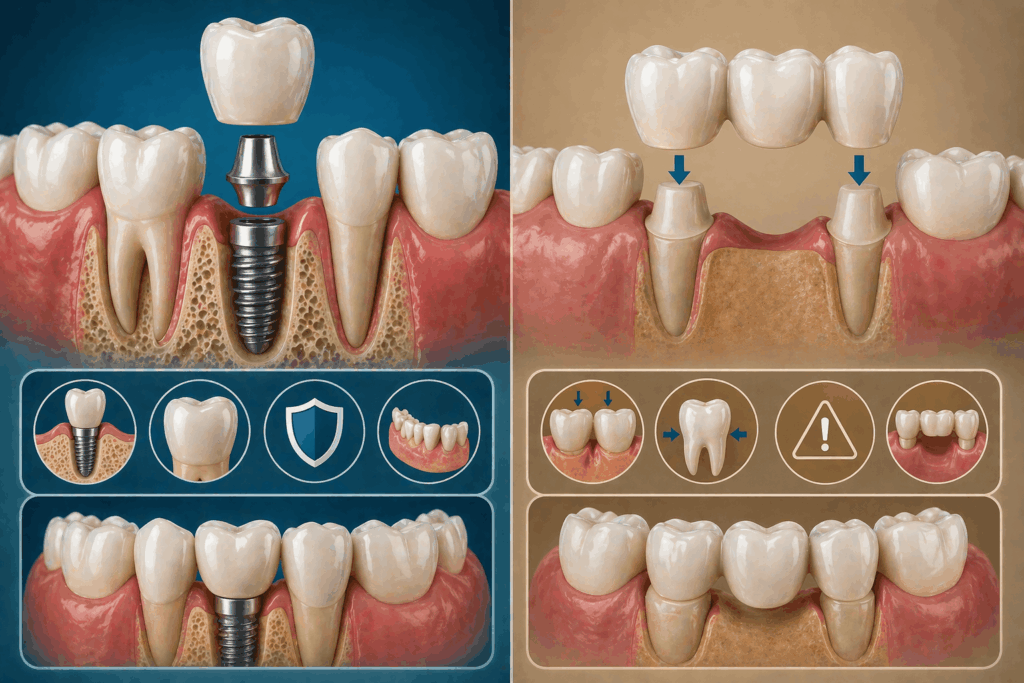
Comparing the Paths: Implants vs. Bridges
In our Greenbrier clinic, we often sit down with patients to discuss which restorative path honors their needs and budget.
While dental implants are the “gold standard” for many because they preserve the jawbone, they are a commitment of time—often taking months to fully heal. For some, a dental bridge may be a more immediate solution. If you are curious about the mechanical differences, understanding the care of dental bridge and how do dental bridges work can help you decide if you prefer a non-surgical approach or the permanent foundation of an implant.
| Feature | Dental Implants | Dental Bridges |
| Longevity | 25+ years to a lifetime | 7–15 years |
| Bone Preservation | Stimulates and saves bone | Bone loss continues under the bridge |
| Adjacent Teeth | No impact on neighboring teeth | Requires “prepping” (shaving) healthy teeth |
| Procedure Time | 3–6 months (including healing) | 2–3 weeks |
Local Care for Greenbrier Patients
Choosing where to have your dental implant procedure is a decision rooted in trust. At Greenbrier Dental Excellence, we aren’t just clinicians; we are your neighbors. We operate with a PPO-friendly clinic model, ensuring that high-quality, specialized care is accessible to our community.
Our approach is grounded in:
- Transparency: We explain every step of the “healing seasons” involved in your implant.
- Modern Technology: We use precise imaging to map your jawbone, ensuring the most accurate placement.
- Compassion: We know that dental work can feel daunting. We provide a calm, grounded environment to put your spirit at ease.
Frequently Asked Questions
Who is the “ideal” candidate for dental implants?
The ideal candidate is an adult with good oral and systemic health, sufficient jawbone density to support the implant, and a commitment to maintaining excellent oral hygiene.
Can I get implants if I have a “bite” problem or grind my teeth?
Yes, but we may need to address the grinding (bruxism) first. We often recommend a custom nightguard to protect your new “investment” from the heavy forces of grinding while you sleep.
Does the procedure hurt?
Most patients in our Greenbrier office report that the procedure involves less discomfort than a tooth extraction. We use local anesthesia to ensure you are comfortable, and the recovery period is usually managed with simple over-the-counter care.
How long do dental implants last?
When properly cared for through brushing, flossing, and regular visits to Greenbrier Dental Excellence, an implant can last the rest of your life. It is designed to be a permanent part of your anatomy.
What if I am missing all of my teeth?
You may still be an excellent candidate! We offer solutions like “All-on-4” or implant-supported dentures, which use a few strategically placed implants to secure a full arch of teeth, restoring both function and confidence